Past Events
Primary tabs
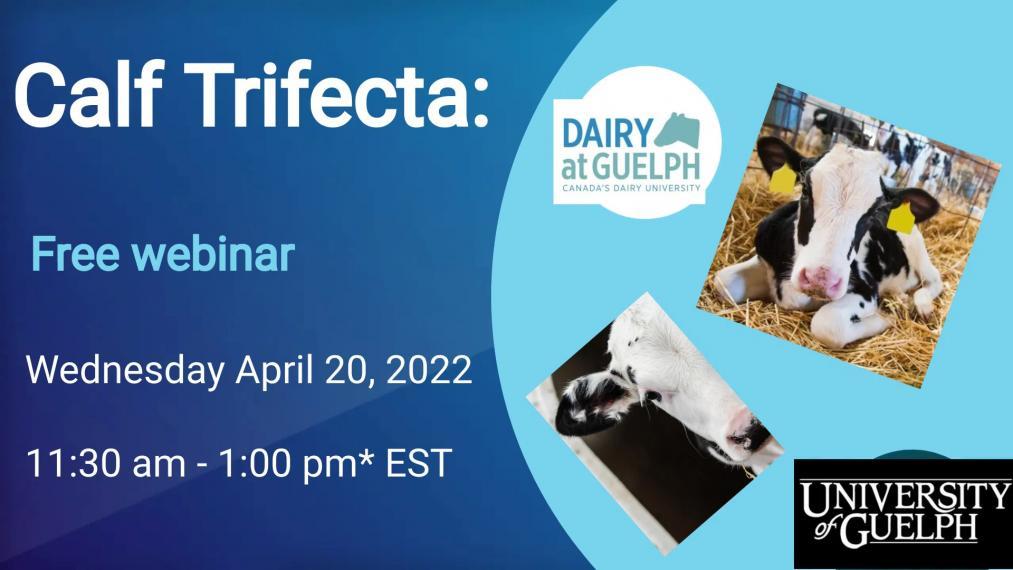
Healthy Calf, Health Future: Calf Trifecta, April 20th, 2022
Are you eager to learn about the newest concepts in calf management? Are you interested in the opportunity to listen to world class experts in calf nutrition, health and welfare? Here's your chance! Register today to attend our online webinar ‘Healthy Calf, Healthy Future: Calf Trifecta’. This webinar will be held Wednesday, April 20th, 2022, from 11:30 AM- 1:00 PM EST via Zoom, hosted by a fantastic group of graduate students in the Department of Animal Biosciences at the University of Guelph.&
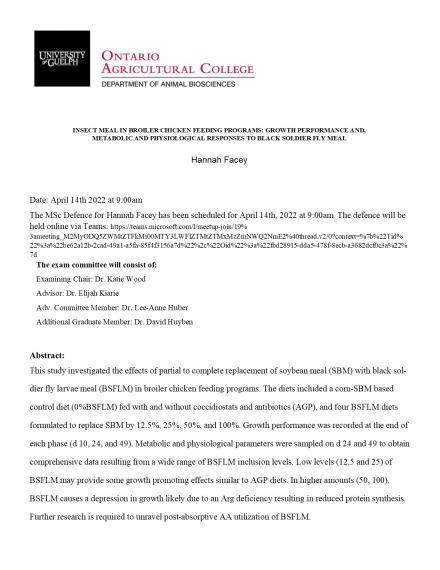
Hannah Facey's MSc Defence
This study investigated the effects of partial to complete replacement of soybean meal (SBM) with black soldier fly larvae meal (BSFLM) in broiler chicken feeding programs. The diets included a corn-SBM based control diet (0%BSFLM) fed with and without coccidiostats and antibiotics (AGP), and four BSFLM diets formulated to replace SBM by 12.5%, 25%, 50%, and 100%. Growth performance was recorded at the end of each phase (d 10, 24, and 49). Metabolic and physiological parameters were sampled on d 24 and 49 to obtain comprehensive data resulting from a wide range of BSFLM inclusion levels.
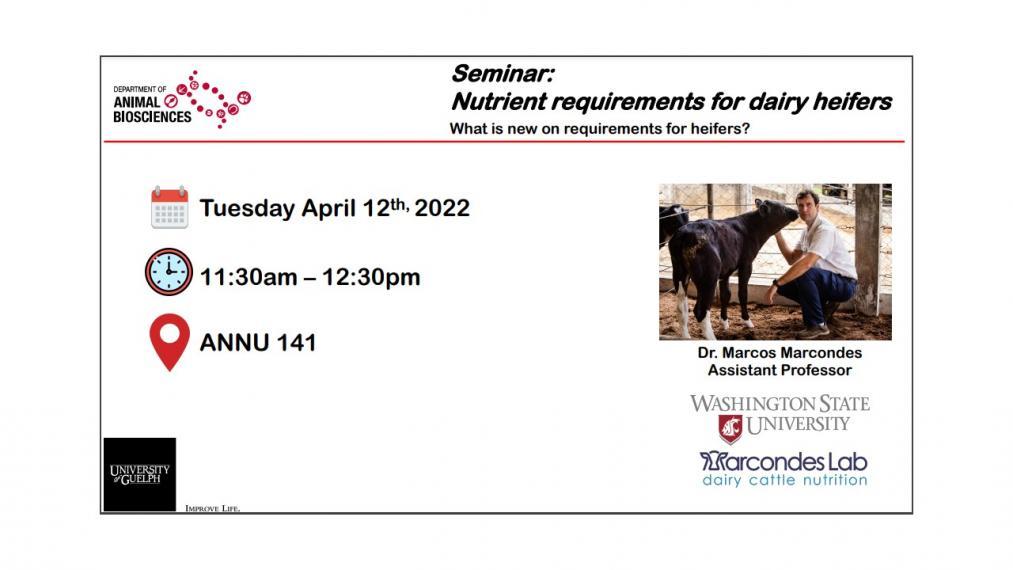
Seminar: Nutrient Requirements for Dairy Heifers
Dr. Marcos Marcondes obtained his Bachelor's degree in Animal Science as well as a Master's (2007) and Doctorate (2010) at the Federal University of Viçosa. This was follwed by a postdoctoral period at the University of Florida from 2018-2019. He served as professor in Dairy Cattle Management and Nutrition at the UFV from 2010-2020, and in 2021 transferred to Washington State University as professor of Dairy Cattle Nutrition.
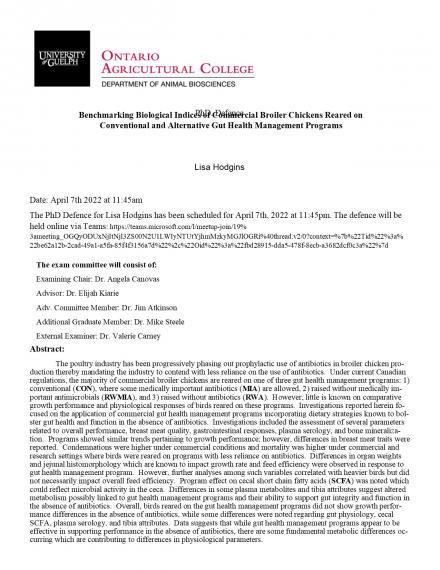
Lisa Hodgin's PhD Defence
The poultry industry has been progressively phasing out prophylactic use of antibiotics in broiler chicken pro-duction thereby mandating the industry to contend with less reliance on the use of antibiotics. Under current Canadian regulations, the majority of commercial broiler chickens are reared on one of three gut health management programs: 1) conventional (CON), where some medically important antibiotics (MIA) are allowed, 2) raised without medically im-portant antimicrobials (RWMIA), and 3) raised without antibiotics (RWA).
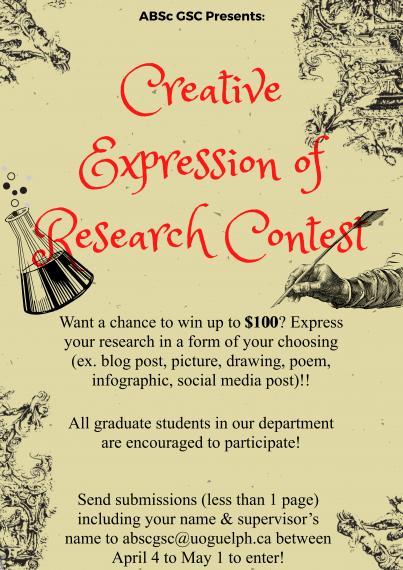
The ABSC GSC Presents The CREATIVE EXPRESSION of Research Competition
Animal Biosciences Graduate Students-Are you READY for our second CREATIVE EXPRESSION OF RESEARCH competition!?
Animal Biosciences Grad Students we want YOU to submit your research with a CREATIVE TWIST which could take the form of a picture, a song, a twitter or blog post, an infographic, or WHATEVER creative way YOU can think up!! Submissions are made individually, and ALL Grad Students are WELCOME and ENCOURAGED to participate.
CNM Virtual Seminar - Out with Old, In with the New? Not so Fast! Traditional Feed Ingredients Meet Modern Science
Welcome to the March Installment of the 2022 ‘Virtual’ Nutrition Seminar Series, hosted by the Centre for Nutrition Modelling out of the Department of Animal Biosciences. Each month in 2022 we will continue to deliver seminars from a different lab within the Nutrition group, and share their exciting new research in a dynamic virtual manner.