 |
Sydney MoorePosition/Title: MSc Candidate email: smoore12@uoguelph.ca Phone: Office: ANNU 218 |
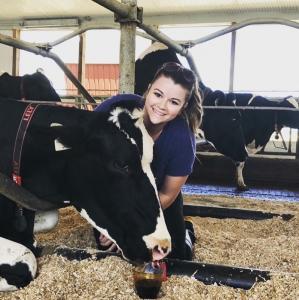
I am currently a MSc student studying dairy cow behaviour and welfare under the supervision of Dr. Trevor DeVries. I completed my undergraduate degree in Animal Biology here, at the University of Guelph, and found my passion for research while working as an undergraduate research assistant in my third and fourth years of school. In my third year, I was fortunate enough to work for Dr. Ira Mandell, studying beef and pig nutrition. In my fourth year, my interest in Dairy was sparked when I worked for Dr. Trevor DeVries and ran a research trial at the Elora Dairy Research station. These past work experiences led me on a whole new career path I never would have imagined for my suburban-raised self.
My thesis research is focused on supplementing a molasses-based liquid feed (in addition to their normal feed and pellets) to early lactation dairy cows milked in robotic milking systems. The objective is to determine the effect of liquid molasses on cow health, behaviour and production. Cows at six robotic milking farms in Ontario were enrolled and randomly assigned to either a control diet (no molasses, just robot pellet) or a molasses-based liquid feed diet (molasses and robot pellet). Due to the high energy demands for milk production, essentially all dairy cows will experience negative energy balance in early lactation. Negative energy balance occurs when cows expend more energy into their milk than what they can obtain through dietary sources. Cows milked in robots are at a higher risk as these systems allow for more frequent milking than conventional systems. This can increase milk yield and thus, the energy demands required. Typically, farmers will provide robot pellets, which are high in starch, to try and account for these energy demands. This is problematic as excessive pellet intake can increase the risk of having a low rumen pH (i.e. subacute ruminal acidosis). By supplementing liquid molasses to cows directly in the robot, I hope to provide energy to cows without increasing risks of common health disorders associated with high starch feeds. Overall, I hope my results will contribute knowledge to Canadian dairy farmers using robots, to effectively manage negative energy balance. I am currently still in the data analysis stage, but I am excited to see what results are generated!
During my free time, I enjoy spending time with friends and family, or curling up with my bunny and a good book! I hope to pursue research in the future by obtaining my PhD and pursuing a career in academia.